


Have you ever wondered why some hair products work amazingly for other people but seem ineffective on your hair? The answer may have nothing to do with the product itself and everything to do with your hair porosity.
Hair porosity is one of the most important yet overlooked factors in hair care. It determines how well your hair absorbs and retains moisture, which directly affects hydration, softness, shine, and overall hair health.
Understanding your hair porosity can help you choose the right products, avoid unnecessary damage, and build a hair care routine that actually delivers results.
In this guide, you’ll learn what hair porosity is, the different porosity levels, how to test your hair porosity correctly, and how to care for your hair based on your results.
What Is Hair Porosity?
Why Hair Porosity Matters
The Three Types of Hair Porosity
How to Test Hair Porosity
Hair Porosity Comparison Chart
Signs of Low Porosity Hair
Signs of High Porosity Hair
Best Products for Each Hair Porosity Type
FAQ
Final Thoughts
What Is Hair Porosity?
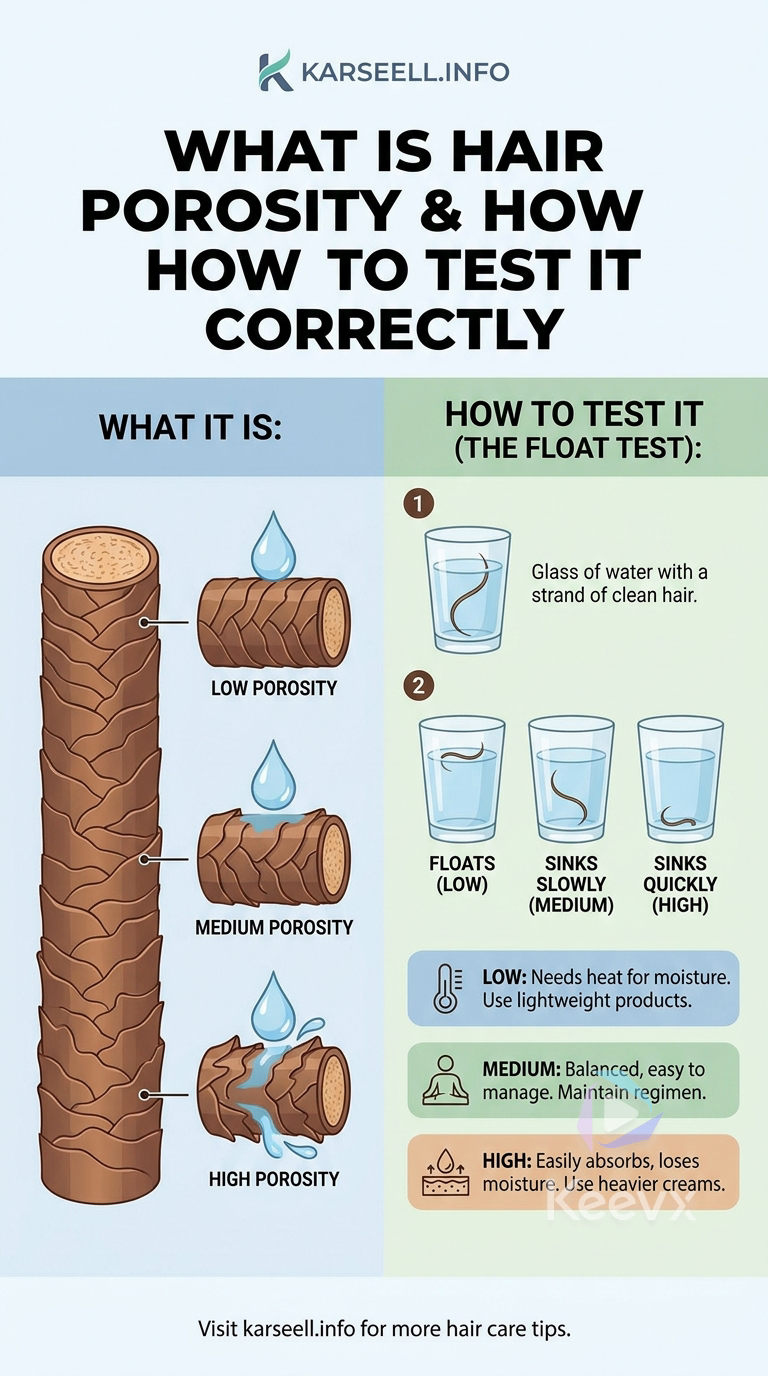
Hair porosity refers to your hair’s ability to absorb and retain moisture.
Each strand of hair is covered by an outer protective layer called the cuticle. The condition of this cuticle determines how easily moisture and hair care products can enter and leave the hair shaft.
Hair porosity generally falls into three categories:
- Low Porosity Hair
- Medium Porosity Hair
- High Porosity Hair
Each type behaves differently and requires specific care.
Best Products for Each Hair Porosity Type
Low Porosity Hair
Lightweight leave-in conditioners
Water-based moisturizers
Clarifying shampoos
Medium Porosity Hair
Hydrating conditioners
Occasional protein treatments
Moisturizing hair masks
High Porosity Hair
Deep conditioning masks
Leave-in conditioners
Moisture-sealing oils
Protein treatments
Best Hair Mask for High Porosity Hair
High porosity hair often struggles to retain moisture, making deep conditioning an essential part of a healthy hair care routine. Karseell Collagen Hair Mask helps improve hydration, softness, and manageability while reducing the appearance of dryness and frizz.
It is particularly beneficial for hair that has been damaged by bleaching, coloring, heat styling, or chemical treatments.
Why Hair Porosity Matters
Many people focus on hair type, such as straight, wavy, curly, or coily hair. While hair type is important, porosity often has a greater impact on how your hair responds to products and treatments.
Hair porosity influences:
- Moisture absorption
- Moisture retention
- Product effectiveness
- Drying time
- Hair elasticity
- Frizz levels
- Overall hair health
Knowing your porosity can help you avoid wasting money on products that are not suitable for your hair.
Understanding the Three Types of Hair Porosity
Low Porosity Hair
Low porosity hair has tightly packed cuticles.
Because the cuticles lie very flat, moisture has difficulty entering the hair shaft.
Common Characteristics
- Water beads on the hair surface
- Hair takes a long time to get fully wet
- Products tend to sit on top of the hair
- Hair dries slowly
- Product buildup occurs easily
- Hair often appears shiny
Challenges
Although low porosity hair may look healthy, it can be difficult to hydrate because moisture struggles to penetrate the hair strand.
Medium Porosity Hair
Medium porosity hair is often considered the ideal balance.
The cuticle is slightly open, allowing moisture to enter and remain inside the hair without excessive loss.
Common Characteristics
- Easily absorbs moisture
- Retains hydration well
- Responds well to hair products
- Maintains shine and softness
- Usually requires less maintenance
Benefits
People with medium porosity hair often find it easier to maintain healthy, manageable hair.
High Porosity Hair
High porosity hair has raised or damaged cuticles.
Moisture enters the hair quickly but also escapes rapidly.
Common Characteristics
- Absorbs water immediately
- Dries very quickly
- Frequently feels dry
- Frizz is common
- Hair tangles easily
- More prone to breakage
Causes
High porosity can occur naturally, but it is often caused by:
- Bleaching
- Hair coloring
- Heat styling
- Chemical treatments
- Environmental damage
How to Test Hair Porosity Correctly
Many porosity tests are shared online, but some are more reliable than others.
Let’s examine the most common methods.
The Water Spray Test
This is one of the easiest and most accurate ways to test hair porosity.
How to Perform the Test
- Start with clean hair free of products.
- Lightly spray a small section of hair with water.
- Observe how the water behaves.
Results
Low Porosity
Water remains on the surface and forms droplets.
Medium Porosity
Water absorbs gradually over several minutes.
High Porosity
Water absorbs almost instantly.
This method provides a realistic view of how your hair interacts with moisture.
The Slip and Slide Test
This test helps evaluate the condition of the hair cuticle.
How to Perform the Test
- Take a clean strand of hair.
- Slide your fingers from the tip toward the scalp.
Results
Smooth Texture
Typically indicates low or medium porosity.
Rough Texture
Often indicates high porosity due to raised cuticles.
The Drying Time Test
Hair drying speed can reveal valuable information.
Low Porosity Hair
Takes a long time to dry because water remains on the surface.
Medium Porosity Hair
Dries at a normal rate.
High Porosity Hair
Dries very quickly because moisture enters and escapes rapidly.
| Feature | Low Porosity | Medium Porosity | High Porosity |
|---|---|---|---|
| Water Absorption | Slow | Moderate | Fast |
| Moisture Retention | High | Balanced | Low |
| Drying Time | Long | Normal | Fast |
| Frizz Risk | Low | Moderate | High |
| Product Buildup | High | Low | Low |
The Float Test: Is It Reliable?
The float test is one of the most popular methods online.
How It Works
- Place a clean strand of hair into a glass of water.
- Observe whether it floats or sinks.
Common Interpretation
- Floating = Low Porosity
- Middle = Medium Porosity
- Sinking = High Porosity
The Problem
Hair strands can be affected by:
- Product residue
- Oils
- Hair thickness
- Air bubbles
Because of these variables, many hair professionals consider the float test less reliable than the spray test.
Signs You Have Low Porosity Hair
You may have low porosity hair if:
- Hair takes hours to dry
- Products sit on the surface
- Hair feels greasy easily
- Deep conditioners struggle to penetrate
- Water beads on the hair
Signs You Have High Porosity Hair
You may have high porosity hair if:
- Hair dries very quickly
- Hair becomes frizzy easily
- Ends feel rough
- Hair tangles frequently
- Moisture disappears quickly
How to Care for Low Porosity Hair
Use Lightweight Products
Heavy products can create buildup.
Apply Heat During Treatments
Warm towels can help open the cuticle and improve product absorption.
Clarify Regularly
Removing buildup helps products perform better.
Avoid Excessive Oils
Too many oils can sit on the surface without providing hydration.
How to Care for High Porosity Hair
Focus on Deep Conditioning
Regular deep conditioning helps improve moisture retention.
Use Moisturizing Hair Masks
Hydrating treatments can help replenish lost moisture.
Limit Heat Styling
Excessive heat can worsen cuticle damage.
Seal Moisture
Leave-in conditioners and nourishing treatments can help lock hydration into the hair.
Why Hair Masks Are Important for Porosity Management
Regardless of your porosity level, maintaining proper moisture balance is essential.
For individuals with medium and high porosity hair, deep-conditioning treatments can be especially beneficial because they help restore hydration and improve softness.
Products like the Karseell Collagen Hair Mask are often used to support moisture retention and improve manageability, particularly for dry, damaged, color-treated, or heat-stressed hair.
FAQ
Can low porosity hair become high porosity?
Yes. Excessive heat styling, bleaching, coloring, and chemical treatments can gradually increase hair porosity over time.
How often should I deep condition high porosity hair?
Most people with high porosity hair benefit from deep conditioning once or twice per week, depending on the level of dryness and damage.
Does bleaching increase hair porosity?
Yes. Bleaching lifts the hair cuticle and can make hair more porous, leading to faster moisture loss.
Can curly hair have low porosity?
Absolutely. Hair texture and hair porosity are different characteristics. Curly hair can have low, medium, or high porosity.
What is the best hair mask for high porosity hair?
Deep conditioning masks rich in moisturizing ingredients and proteins can help improve moisture retention and reduce breakage.
Can hair porosity change over time?
Yes. Heat styling, coloring, bleaching, chemical treatments, and environmental exposure can increase hair porosity over time.
Is high porosity hair damaged?
Not always. Some people naturally have high porosity hair. However, excessive heat and chemical treatments often increase porosity.
What products are best for low porosity hair?
Lightweight leave-in conditioners, water-based moisturizers, and products that do not create buildup work best.
Can I have different porosity levels on the same head?
Yes. Hair ends are often more porous than roots due to age and exposure to damage.
Understanding hair porosity is one of the most valuable steps you can take toward healthier hair. By learning how your hair absorbs and retains moisture, you can make smarter decisions about products, treatments, and daily hair care routines.
The water spray test remains one of the simplest and most reliable ways to determine your hair porosity. Once you know whether your hair is low, medium, or high porosity, you can customize your routine to improve hydration, reduce frizz, and achieve healthier-looking hair.
When paired with proper cleansing, conditioning, and moisture-rich treatments, understanding your hair porosity can transform the way you care for your hair and help you achieve better long-term results.