


Hair Porosity Explained: Low, Medium, and High Porosity Hair Guide (2026)
Understanding hair porosity is one of the most important steps toward achieving healthy, hydrated, and beautiful hair. Hair porosity determines how well your hair absorbs moisture, how it reacts to products, and how effectively it retains hydration over time.
Many people spend hundreds of dollars on shampoos, conditioners, oils, and hair masks without understanding why some products work perfectly while others seem ineffective. In many cases, the answer lies in hair porosity.
Whether you have dry hair, frizzy hair, curly hair, bleached hair, or heat-damaged hair, knowing your porosity level can help you build a more effective hair care routine and achieve better results.
In this complete guide, you’ll learn everything about low, medium, and high porosity hair, how to test your porosity at home, the best ingredients for each porosity type, and how to choose the right products for healthier-looking hair.
If your hair often feels dry or dehydrated, you may also want to read our Best Hair Mask for Dry Hair in Canada guide.
What Is Hair Porosity?
Hair porosity refers to your hair’s ability to absorb and retain moisture.
Every hair strand is covered by a protective outer layer called the cuticle. The condition of this cuticle determines how easily water, oils, and hair care products enter and remain inside the hair shaft.
When the cuticle is tightly closed, moisture has difficulty entering the hair.
When the cuticle is open or damaged, moisture enters quickly but escapes just as fast.
This is why two people can use the same hair mask and experience completely different results.
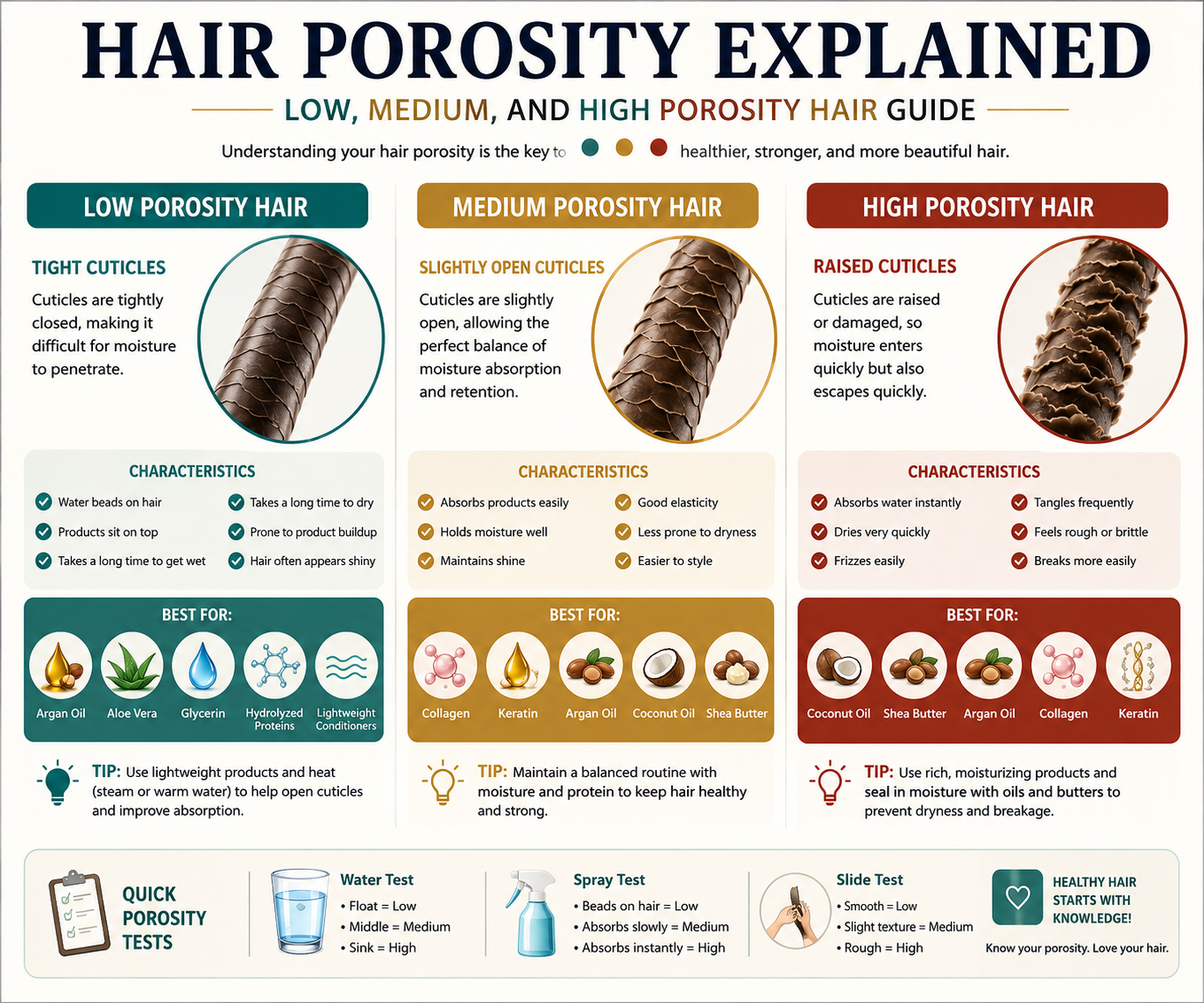
Hair porosity is generally divided into three categories:
Low Porosity Hair
Low porosity hair has tightly packed cuticles that resist moisture penetration.
Medium Porosity Hair
Medium porosity hair has a balanced cuticle structure that allows moisture to enter and remain inside effectively.
High Porosity Hair
High porosity hair has raised or damaged cuticles that absorb moisture quickly but lose it rapidly.
Understanding your porosity level helps you select the right hair products and avoid unnecessary frustration.
Why Hair Porosity Matters
Many common hair problems are directly related to porosity.
Hair porosity influences:
- Moisture absorption
- Moisture retention
- Product effectiveness
- Hair softness
- Frizz levels
- Elasticity
- Shine
- Drying time
If your hair always feels dry no matter how many products you use, porosity may be the missing piece of the puzzle.
People with high porosity hair often struggle with dryness and frizz, while people with low porosity hair may find that products simply sit on the surface without absorbing properly.
How Hair Cuticles Affect Moisture
The cuticle acts like a protective shield.
Imagine roof shingles overlapping each other.
When the shingles are tightly closed, water cannot easily enter.
When they are raised or damaged, water enters quickly but also escapes easily.
This simple concept explains why porosity plays such a major role in overall hair health.
Healthy hair typically maintains a balanced cuticle structure that allows moisture to move in and stay locked inside.
The Three Types of Hair Porosity
Low Porosity Hair
Low porosity hair is often considered resistant hair because moisture struggles to penetrate the cuticle layer.
While this can help protect the hair from environmental damage, it also makes hydration more difficult.
Characteristics of Low Porosity Hair
- Water beads on the hair surface
- Products sit on top of the hair
- Hair takes a long time to get wet
- Hair takes a long time to dry
- Product buildup occurs easily
- Hair often appears shiny
Best Ingredients for Low Porosity Hair
- Argan oil
- Aloe vera
- Glycerin
- Hydrolyzed proteins
- Lightweight conditioners
Medium Porosity Hair
Medium porosity hair is often considered the ideal balance.
The cuticle is slightly open, allowing moisture to enter while still retaining hydration effectively.
Characteristics of Medium Porosity Hair
- Absorbs products easily
- Holds moisture well
- Maintains shine
- Good elasticity
- Less prone to dryness
Best Ingredients for Medium Porosity Hair
- Collagen
- Keratin
- Argan oil
- Coconut oil
- Shea butter
People with medium porosity hair often benefit from collagen-based treatments.
For a complete breakdown, read our Karseell Collagen Hair Mask Review.
High Porosity Hair
High porosity hair has raised, damaged, or widely spaced cuticles.
While this allows moisture to enter quickly, it also causes hydration to escape rapidly.
This is one of the most common reasons people struggle with chronic dryness and frizz.
Characteristics of High Porosity Hair
- Absorbs water instantly
- Dries very quickly
- Frizzes easily
- Tangles frequently
- Feels rough or brittle
- Breaks more easily
- Lacks shine
Common Causes of High Porosity Hair
Bleaching
Bleaching is one of the most common causes of high porosity hair.
If your hair has been affected by bleaching, check out our Best Hair Mask for Bleached Hair guide.
Hair Coloring
Frequent coloring can gradually weaken the cuticle layer and increase porosity.
Heat Styling
Flat irons, curling irons, and blow dryers expose hair to high temperatures that damage the protective outer layer.
If heat styling has damaged your hair, read our How to Repair Hair Damaged by Straightening guide.
Chemical Treatments
Relaxers, perms, and straightening treatments can significantly alter the hair structure.
Environmental Stress
Sun exposure, pollution, wind, and harsh weather conditions can gradually damage the cuticle over time.
How to Test Your Hair Porosity at Home
The Water Glass Test
Place a clean strand of hair into a glass of water.
Results:
- Floats = Low Porosity
- Suspended in the middle = Medium Porosity
- Sinks quickly = High Porosity
The Spray Bottle Test
Spray water onto clean hair.
Results:
- Water remains on the surface = Low Porosity
- Water absorbs slowly = Medium Porosity
- Water absorbs instantly = High Porosity
The Slide Test
Take a strand of hair and slide your fingers upward from the ends toward the scalp.
Results:
- Smooth surface = Low Porosity
- Slight texture = Medium Porosity
- Rough texture = High Porosity
Frequently Asked Questions (FAQ)
What is hair porosity?
Hair porosity refers to your hair’s ability to absorb and retain moisture. It is determined by the condition of the hair cuticle and affects how well hair responds to products and treatments.
What causes high porosity hair?
High porosity hair is often caused by bleaching, coloring, heat styling, chemical treatments, and environmental damage. These factors can weaken the cuticle and make it easier for moisture to escape.
Can hair porosity change over time?
Yes. Hair porosity can increase due to damage and improve with proper hair care, deep conditioning treatments, and reduced exposure to heat and chemicals.
Which porosity type is best?
Medium porosity is generally considered the easiest to manage because it allows moisture to enter the hair while retaining hydration effectively.
Is collagen good for high porosity hair?
Yes. Collagen-based treatments can help improve softness, elasticity, hydration, and overall hair appearance, making them beneficial for high porosity hair.
How often should high porosity hair use a hair mask?
Most people with high porosity hair benefit from using a deep conditioning hair mask two to three times per week, depending on the level of dryness and damage.
Conclusion
Understanding your hair porosity is one of the most effective ways to improve your hair care routine. Whether you have low, medium, or high porosity hair, choosing products that match your porosity level can dramatically improve hydration, softness, shine, and overall hair health.
By identifying how your hair absorbs and retains moisture, you can stop wasting money on products that don’t work and focus on solutions that truly meet your hair’s needs. From deep conditioning treatments to collagen-based hair masks, the right routine can help reduce frizz, strengthen hair fibers, and improve manageability.
If your hair is also affected by dryness, damage, frizz, or chemical treatments, be sure to explore our guides on Best Hair Mask for Dry Hair in Canada, Best Hair Mask for Damaged Hair in Canada, Best Hair Mask for Frizzy Hair, and Best Hair Mask for Curly Hair.
Many users also combine treatments featured in our Karseell Collagen Hair Mask Review and Karseell Collagen Hair Mask Reviews articles to build a complete moisture and repair routine. With consistent care and the right products, healthier, softer, and more manageable hair is absolutely achievable.