


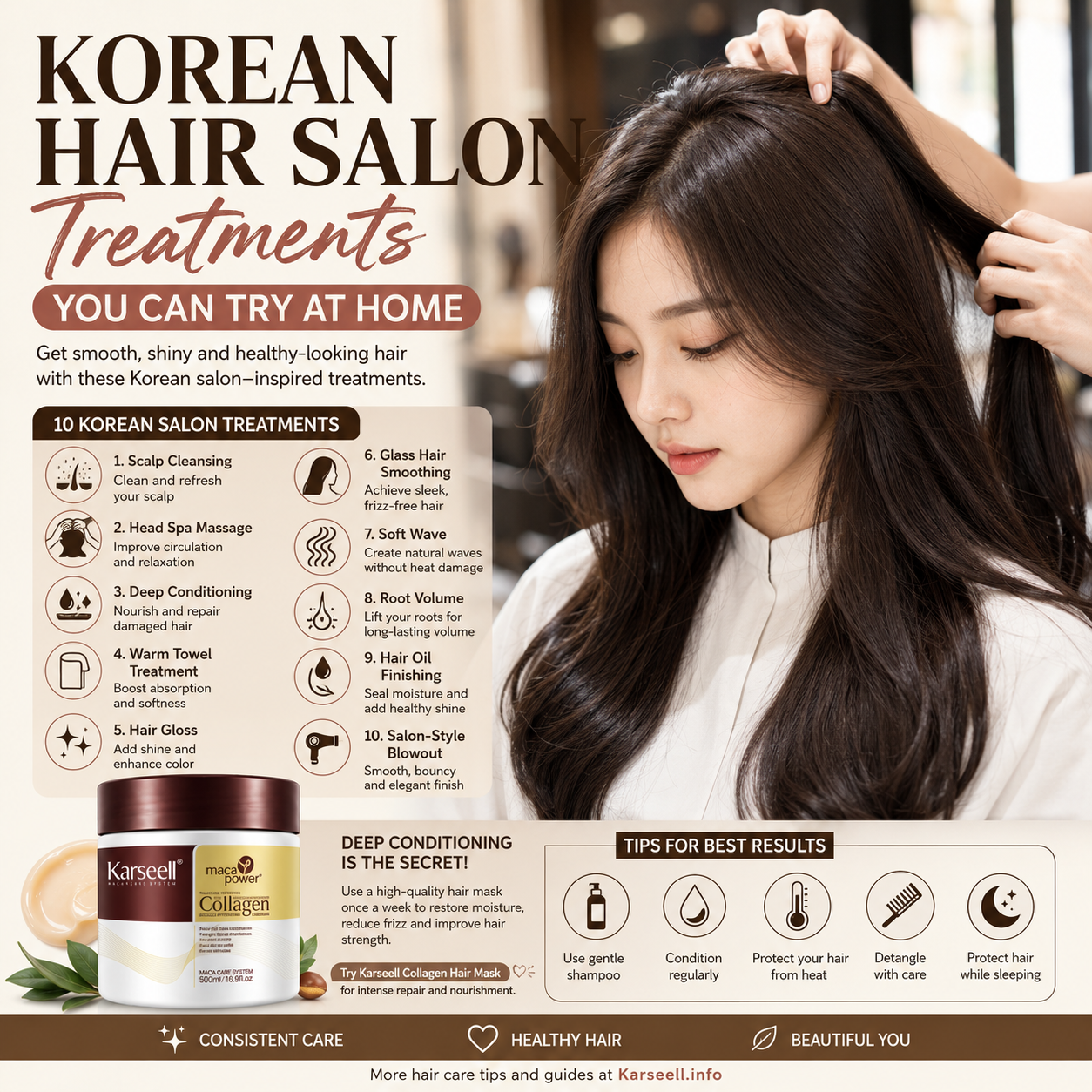
Korean hair salons are known for creating hair that looks smooth, glossy, soft, and carefully styled. Many people search for Korean hair salon treatments because they want the polished “glass hair” appearance often seen in Korean beauty content.
The good news is that you do not always need an expensive salon appointment to improve the appearance of dry, frizzy, or dull hair.
With a gentle scalp-cleansing routine, regular conditioning, a deep-conditioning mask, careful drying, and controlled heat styling, you can create a Korean salon-inspired hair routine at home.
This guide explains which Korean-inspired treatments you can safely try at home, how to adapt them to your hair type, and which salon procedures should be left to a professional.
What Is a Korean Hair Salon Treatment?
The phrase Korean hair salon treatment does not describe one single standardized service.
It may refer to several different services, including:
- Scalp cleansing and analysis
- Head-spa treatments
- Deep conditioning
- Steam treatments
- Hair gloss treatments
- Damage-repair services
- Smoothing treatments
- Korean perms
- Root-volume treatments
- Professional blowouts
Korean-inspired hair care is often associated with treating the scalp carefully while also improving the softness, shine, movement, and manageability of the hair lengths.
At home, the safest approach is to focus on cleansing, hydration, conditioning, gentle detangling, scalp massage, and heat protection rather than attempting strong chemical salon services yourself.
Can You Get Korean Salon Hair at Home?
You can recreate some of the cosmetic results of a Korean salon routine at home, especially when your goals are:
- Softer hair
- More shine
- Less visible frizz
- Improved manageability
- A cleaner-feeling scalp
- A smoother blowout
- Better curl or wave definition
However, an at-home routine cannot perfectly duplicate every professional treatment.
Chemical straightening, bleaching, permanent coloring, root-volume perms, and digital perms require product knowledge, precise timing, and professional application. Incorrect use may cause scalp irritation, breakage, or severe hair damage.
At home, concentrate on improving the condition and appearance of your hair without changing its chemical structure.
1. Korean-Inspired Scalp Cleansing Treatment
A clean scalp is the foundation of a polished hair-care routine.
Oil, sweat, dry skin, styling products, and environmental buildup can make the roots look flat or greasy. However, cleaning the scalp too aggressively can also leave it irritated or dry.
How to Do It
- Brush or detangle your hair gently before washing.
- Wet the scalp thoroughly with lukewarm water.
- Apply shampoo mainly to the scalp.
- Massage gently with your fingertips.
- Allow the shampoo to flow through the lengths while rinsing.
- Repeat only when your scalp has significant buildup.
- Follow with conditioner.
The American Academy of Dermatology recommends applying shampoo primarily to the scalp instead of rubbing it through the full length of the hair. It also recommends washing according to how quickly your scalp becomes oily or dirty.
Avoid These Mistakes
Do not:
- Scratch the scalp with your fingernails
- Use very hot water
- Apply harsh scrubs to an irritated scalp
- Shampoo the hair lengths aggressively
- Use clarifying shampoo every day
- Apply heavy oils immediately after cleansing
A scalp treatment should leave the scalp feeling comfortable—not painful, tight, or inflamed.
2. At-Home Korean Head-Spa Massage
Head-spa videos often include scalp analysis, cleansing, massage, steam, rinsing, and conditioning.
You can recreate the relaxing massage portion at home without expensive equipment.
Simple Scalp-Massage Method
Before or during shampooing:
- Place your fingertips on the scalp.
- Make small, slow circular movements.
- Begin near the hairline.
- Continue toward the crown and back of the head.
- Avoid pulling the hair or scratching the skin.
- Continue for three to five minutes.
The goal is relaxation and even product distribution. A scalp massage should not be presented as a treatment for genetic hair loss, alopecia, infection, or another medical condition.
Stop when the scalp feels painful, inflamed, or sensitive.
3. Deep-Conditioning Hair Mask Treatment
Deep conditioning is one of the easiest ways to recreate the soft, manageable finish associated with salon-treated hair.
A hair mask can be especially helpful when the hair feels:
- Dry
- Rough
- Frizzy
- Tangled
- Dull
- Brittle
- Damaged by heat
- Chemically processed
For more product-selection guidance, read the complete guide to the best hair mask for dry hair in Canada.
How to Apply a Hair Mask
- Wash your scalp and hair.
- Gently remove excess water.
- Divide your hair into sections.
- Apply the mask to the mid-lengths and ends.
- Distribute it carefully with your fingers or a wide-tooth comb.
- Leave it on for the time stated on the product label.
- Rinse thoroughly with lukewarm water.
Avoid applying a thick cosmetic mask directly to an oily, irritated, or inflamed scalp unless the product is specifically designed for scalp application.
Karseell Option for Dry and Damaged Hair
For dry, frizzy, or heat-styled lengths, you can include the Karseell Collagen Hair Mask as the deep-conditioning step in your routine.
Use it according to the label directions and adjust the amount to your hair length, thickness, and condition.
The mask is a cosmetic conditioning treatment. It may improve softness, shine, smoothness, and manageability, but it should not be presented as a medical treatment for hair loss or scalp disease.
4. Warm-Towel Conditioning Treatment
Many salon routines use controlled warmth to make the treatment feel more luxurious.
At home, you can use a warm towel instead of purchasing a professional steamer.
How to Do It Safely
- Apply your hair mask to clean, damp hair.
- Cover the hair with a shower cap.
- Soak a towel in warm—not boiling—water.
- Remove the excess water.
- Wrap the warm towel around the shower cap.
- Leave it in place for five to ten minutes.
- Remove it and follow the mask directions.
- Rinse thoroughly.
Do not place a very hot towel directly against your scalp. Heat should feel comfortable and should never cause burning or pain.
This method is not required for every mask. Always prioritize the product manufacturer’s instructions.
5. Korean Glass-Hair Smoothing Routine
“Glass hair” generally describes hair that appears exceptionally smooth, straight, reflective, and polished.
The look is usually created by combining:
- Proper conditioning
- Careful detangling
- Smooth blow-drying
- Controlled heat
- Lightweight finishing products
- Regular trimming
It is a visual styling result, not a separate hair type or proof that the hair is free from damage.
At-Home Glass-Hair Steps
- Begin with clean, conditioned hair.
- Remove excess water with a soft towel or cotton T-shirt.
- Apply a lightweight leave-in product.
- Apply heat protectant.
- Divide the hair into manageable sections.
- Blow-dry downward using low or medium heat.
- Direct the airflow from roots toward the ends.
- Finish with a small amount of lightweight serum or oil.
Dermatologists recommend limiting heat exposure, using low or medium settings, and protecting the hair before heat styling. Excessive heat can weaken the hair and contribute to dryness and breakage.
Do Not Chase Shine With Excessive Heat
Using more heat does not necessarily create healthier-looking results.
Too many passes with a flat iron may temporarily smooth the surface while increasing dryness and breakage over time.
For a complete repair routine, visit the guide to the best hair masks for heat-damaged hair in Canada.
6. At-Home Hair Gloss Treatment
A hair gloss is used to enhance shine and, depending on the formula, refresh or adjust the appearance of hair color.
There are two broad categories:
Clear Hair Gloss
A clear gloss is designed mainly to improve the appearance of shine and smoothness without adding noticeable color.
Tinted Hair Gloss
A tinted gloss may temporarily refresh faded color or modify unwanted tones.
Always select a product designed for at-home use and perform the recommended allergy or strand test.
A gloss should not be confused with permanent hair dye, bleach, relaxer, or chemical straightening.
When your hair is already fragile, severely bleached, or breaking, adding another chemical service may worsen the problem.
7. Korean-Style Soft-Wave Treatment Without a Perm
Korean salons often create soft, polished waves using professional setting or digital-perm services.
A permanent wave should not be attempted at home without proper training. However, you can create a temporary Korean-inspired wave using heatless methods.
Heatless Roller Method
- Begin with slightly damp—not soaking wet—hair.
- Apply a lightweight styling product.
- Divide the hair into large sections.
- Wrap each section around a soft roller.
- Allow the hair to dry completely.
- Remove the rollers carefully.
- Separate the waves with your fingers.
- Apply a small amount of finishing serum to the ends.
Large rollers usually create softer movement, while smaller rollers create tighter curls.
Overnight Method
You can also use:
- A heatless curling ribbon
- Loose braids
- Soft foam rollers
- Large twists
Avoid wrapping the hair too tightly. Excessive tension can cause discomfort and stress around the hairline.
8. Root-Volume Styling at Home
Korean root perms are salon services designed to add lift near the scalp.
Instead of attempting a chemical root perm at home, create temporary volume with safer styling methods.
Root-Volume Method
- Apply a lightweight volumizing product near the roots.
- Lift the hair in sections.
- Blow-dry using low or medium heat.
- Direct the hair away from its natural fall.
- Place large rollers at the crown.
- Allow the hair to cool before removing them.
- Finish with a light-hold spray if needed.
Avoid applying heavy masks, oils, or creams directly to the roots when your goal is volume.
Use your richer products mainly on the mid-lengths and ends.
9. Korean-Inspired Hair-Oil Finishing Treatment
Hair oils are often used as a finishing step to reduce the appearance of frizz and add shine.
However, using too much may make fine hair look greasy or flat.
How to Apply Hair Oil
- Begin with one or two drops.
- Rub the product between your palms.
- Smooth it over the ends.
- Apply the remaining product lightly to the mid-lengths.
- Avoid saturating the scalp.
Hair oil does not replace conditioner or repair split ends permanently. It primarily helps improve the cosmetic appearance and feel of the hair.
10. Salon-Style Blowout at Home
The Korean salon look is often completed with a smooth, controlled blowout.
What You Need
- A blow-dryer with adjustable heat
- A concentrator nozzle
- A round or paddle brush
- Hair clips
- Heat protectant
- Lightweight finishing product
Step-by-Step Blowout
- Allow the hair to partially air-dry.
- Apply heat protectant evenly.
- Divide the hair into sections.
- Begin with the lower sections.
- Keep the dryer moving continuously.
- Point the nozzle downward.
- Use controlled tension without pulling aggressively.
- Shape the ends inward or outward.
- Allow each section to cool.
- Finish with a small amount of serum.
The American Academy of Dermatology recommends avoiding rough towel drying, detangling gently, and using the lowest effective heat setting.
Complete Korean Salon-Inspired Routine
Here is a simple routine you can follow once a week.
Step 1: Detangle
Remove knots gently before washing.
Step 2: Cleanse the Scalp
Apply shampoo mainly to the roots and scalp.
Step 3: Condition
Apply conditioner after shampooing, concentrating on the areas that feel dry.
Step 4: Apply a Hair Mask
Use a deep-conditioning mask on the mid-lengths and ends.
Learn how to adjust your schedule in this guide explaining how often you should use a hair mask.
Step 5: Rinse Thoroughly
Product residue can weigh the hair down and reduce movement.
Step 6: Remove Excess Water Gently
Use a microfiber towel or cotton T-shirt. Do not rub the hair aggressively.
Step 7: Apply Leave-In Care
Choose a lightweight product that matches your hair texture.
Step 8: Protect From Heat
Apply heat protectant before blow-drying or using a hot tool.
Step 9: Style
Create a smooth blowout, soft rollers, or heatless waves.
Step 10: Finish Lightly
Apply a small amount of serum or oil to the ends.
For more at-home options, explore these salon-quality hair treatments available in Canada.
Routine by Hair Type
Fine or Oily Hair
Use:
- Lightweight shampoo
- Conditioner mainly on the ends
- A small amount of hair mask
- Minimal oil
- Lightweight volumizing products
Avoid heavy layers of masks, creams, oil, and serum.
Dry or Coarse Hair
Focus on:
- Gentle cleansing
- Richer conditioner
- Regular deep conditioning
- Careful detangling
- Leave-in moisture
- Controlled heat
Curly or Coily Hair
Adapt the routine by:
- Detangling with conditioner
- Working in sections
- Using a moisturizing mask
- Avoiding aggressive brushing
- Using a diffuser or heatless method
- Protecting the hair at night
Color-Treated or Bleached Hair
Use:
- Products designed for processed hair
- Lower heat settings
- Less frequent hot-tool use
- Gentle detangling
- Regular conditioning
- A routine that balances moisture without excessive buildup
Do not combine several strong chemical services at home.
Korean Salon Treatments You Should Not Try at Home
Some procedures are better performed by an experienced stylist.
These include:
- Digital perms
- Chemical root perms
- Permanent straightening
- Hair rebonding
- Strong keratin-smoothing services
- Bleaching
- Major color correction
- Relaxing
- Multiple chemical services in one session
Professional chemical treatments require precise product selection, timing, application, ventilation, and scalp protection.
Attempting them incorrectly can cause:
- Hair breakage
- Uneven texture
- Scalp irritation
- Chemical burns
- Severe dryness
- Unwanted color results
The AAD advises spacing chemical services and limiting practices that repeatedly damage fragile hair.
Common Mistakes to Avoid
Using Too Much Product
Layering shampoo, conditioner, mask, leave-in cream, oil, serum, and styling spray may leave the hair heavy or greasy.
Start with small amounts.
Applying a Hair Mask to the Scalp
Most cosmetic hair masks are intended mainly for the hair lengths. Applying a thick mask to an oily scalp may create buildup.
Using Very Hot Water
Very hot water may leave the scalp uncomfortable and can make dry hair more difficult to manage.
Use lukewarm water.
Styling Soaking-Wet Hair With High Heat
Remove excess water gently and allow the hair to partially dry before beginning a blowout.
Skipping Heat Protectant
Heat protectant should be applied before blow-drying, straightening, or curling.
Flat-Ironing the Same Section Repeatedly
Use the lowest effective temperature and minimize repeated passes.
Copying a Routine Without Considering Hair Type
A routine designed for fine, straight hair may not provide enough conditioning for thick, curly, or coily hair.
Choose products and techniques based on your own scalp, texture, density, and level of damage.
Frequently Asked Questions
What treatments do Korean hair salons offer?
Services vary by salon, but they may include scalp cleansing, head-spa treatments, hair masks, glossing, smoothing, coloring, digital perms, root-volume services, and professional styling.
Can I do a Korean hair treatment at home?
You can recreate the cleansing, massage, conditioning, hair-mask, gloss, roller, and blowout portions of a salon-inspired routine. Chemical perms, bleaching, rebonding, and permanent straightening should be left to trained professionals.
How can I get Korean glass hair at home?
Begin with clean and conditioned hair, use a lightweight leave-in treatment and heat protectant, blow-dry in sections, and finish with a small amount of serum. The smooth appearance requires consistent care and controlled styling—not excessive heat.
Is Karseell a Korean hair product?
Karseell should not be described as Korean unless the manufacturer explicitly confirms that origin. It can be included in a Korean salon-inspired routine as a deep-conditioning option for dry or damaged hair, but that does not make it a Korean salon product.
How often should I use a deep-conditioning mask?
Frequency depends on your hair type, the specific formula, and the product instructions. Many people begin with once a week and adjust based on whether their hair feels dry, heavy, stiff, or coated.
Can I leave a hair mask on overnight?
Only leave a product on overnight when the manufacturer specifically identifies it as an overnight treatment. Leaving a rinse-out mask on longer than instructed does not guarantee better results.
Do Korean hair treatments repair split ends?
Conditioning treatments may temporarily make split ends look smoother, but they cannot permanently fuse severely split hair. Trimming is the most reliable way to remove split ends.
Can a Korean salon routine help hair grow?
A cosmetic routine may help reduce avoidable breakage and improve the appearance of existing hair. It cannot treat genetic hair loss, alopecia, hormonal hair loss, or a medical scalp condition.
When should I see a dermatologist?
Consult a qualified healthcare professional when you experience sudden shedding, bald patches, scalp pain, persistent itching, sores, inflammation, or unexplained thinning.
Final Thoughts
You do not need to perform complicated chemical treatments to create a Korean salon-inspired hair routine at home.
The most useful steps are often the simplest:
- Clean the scalp gently
- Condition after shampooing
- Apply a deep-conditioning mask when needed
- Detangle carefully
- Protect the hair from heat
- Use lower styling temperatures
- Finish with lightweight products
- Select techniques that suit your hair type
A consistent routine can help dry, frizzy, heat-styled, or processed hair look softer, smoother, shinier, and easier to manage.
For more product guides and damaged-hair routines, visit Karseell.info.